Manual de vegetación urbana para Guadalajara, Jalisco (Urban vegetation manual for Guadalajara, Jalisco)
By: Coordinated by Alejandro Zohn, with the collaboration of Yves Bernard Medina (Agricultural Engineer), Francisco Eduardo Moreno Santana (Architect), Dr. Enrique Estrada Faudón and Daniel Zepeda Martín del Campo.
Publisher: Ayuntamiento de Guadalajara / Banco Promex / Editorial Agata.
Date: 1995.
Language: Spanish language (no translation)
271 pages. Softcover. More than 100 b/w illustrations of the form and details of all species listed.
Condition: USED, the front cover has a slight crease and several small nicks along its lower edge; otherwise clean and tight. Price: $30.00
This is an exceptionally hard-to-find item, with no other copies currently available on the web.
This book covers 79 types of tree, 16 types of shrub, 3 climbing plants and 3 ground covers.
Each species has a double-page spread devoted to it, providing details which include:
Common name, Latin name, family; size, shade/sun; origin; growth rate with a table; root system; propogation; association with other species; watering and humidity requirements; soil preference; transplanting; susceptibility to air pollution, plagues; fertilizer requirements; space requirements; pruning; landscape value, etc etc. etc.
Besides this extensive catalog of species, the final chapters discuss the extent to which groups of different species share similar characteristics; the connections of urban vegetation to other urban elements and general considerations related to urban landscapes.
The book includes a glossary, bibliography and index.
From back cover:
“Neill James, a well-bred, single woman of privileged background, wrote this in 1944 while on a supposed six-month tour of Mexico. Little did she know that, as a result of a couple of natural disasters and her own perverse disposition, she would spend the next fifty years in the small mountain village of Ajijic until her death at the age of ninety-nine.”
“Miss James has written three other books in the “Petticoat Vagabond” series about her adventures in cultures as different from hers as she could find, around the world. Dust on my Heart is the last travel book she wrote.”
As Cathey Merrill writes in a brief review for LibraryThing, “What an adventurous book and fun read. I hated to finish it but was happy to learn that she spent the remainder of her life living in Ajijic after she had traveled the world and could have gone anywhere. Neil climbed mountains in many countries but she fell down Popo in Mexico, Paricutin fell on her and then she lived through poisoning. She was tough! … I highly recommend this book – it is one of my favorites.”
I couldn’t have put it better myself – an enjoyable and entertaining read!
This is the reprint (labelled Second Edition) by the Lake Chapala Society, 1977, of the original version published by C. Scribner’s Sons, 1946.
Paperback: 313 pages
Condition: USED (1 copy only). Sun has made spine slighter pinker than remainder of cover. (see scan)
Previous owner’s signature on top of first page; otherwise clean and unmarked.
Price $7.00
The Tarahumar of Mexico, Their Environment and Material Culture contains a wealth of valuable information about one of Mexico’s most distinctive indigenous groups.
The Tarahumar (more commonly, but less correctly, the Tarahumara) live in the Copper Canyon region of Northern Mexico. In many ways, their way of life has remained unchanged for centuries. This area has spectacular scenery, and numerous massive canyons. The main canyon – the Urique Canyon – is longer, deeper and narrower than the US Grand Canyon, so ’spectacular’ is definitely the right word!
The famous Copper Canyon railway, linking Los Mochis and El Fuerte to Divisadero and Creel. passes right through this area.
One subgroup of Tarahumar Indians moves with the seasons from caves near the canyon rim in summer to camps near the canyon floor (at lower altitude where the weather is warmer) during the winter.
The Tarahumar are the subject of several anthropological classics, and this is definitely one of them. This study integrated available archeological data and historical material with extensive field work among the Tarahumar in 1955. The book includes a discussion of agriculture; gardening; tree culture; food preparation; hunting; gathering and fishing; animal husbandry; beverages; ceremonies; games; drug plants; leather, fibers, textiles and personal adornment; and household articles and habitations.
Published by Editorial Agata, Guadalajara, Jalisco, Mexico, 1996. Soft Cover. Book Condition: BRAND NEW (may have minor shelfwear rubbing). A few copies only remain; this publisher is no longer in business.
This book has 33 b/w photographs, 12 full-colour photographs (found only in this edition), and 4 fold out maps in the back pocket (Two maps show the historical boundaries of the Tarahumar country; one map shows Mean annual precipitation, and the fourth map shows physiographic regions; all maps are 1:500,000 scale).
Price: $19.95 Buy here!
This review, by poet James Tipton, first appeared in MexConnect online mazazine.
Tony Burton’s passion is Mexico, and particularly Western Mexico. Most readers of MexConnect find his many articles on Mexico to be both fascinating and useful, articles with titles like “Guayabitos – the Family Vacation Spot,” or the four-part series, “Can Mexico’s Largest Lake Be Saved,” or “Butterflies by the Million: The Monarchs of Michoacán.” Burton currently puts together “Did You Know? Facts About Mexico,” a monthly MexConnect feature, offering answers to such questions as: “Did you know blacks outnumbered Spaniards in Mexico until after 1810?” or “Did you know the oldest winery in the Americas is in Parras de la Fuente” or “Did you know the birth control pill came from Mexican yams?” [Note: all of these articles are accessible in the Lake Chapala Maps – 2008. Obviously Burton is no stranger to our shores here at Lake Chapala.
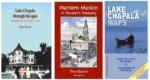
Lake Chapala through the Ages is “a collection of extracts from more than fifty original sources.” In the Introduction, Burton tells us his book “includes extracts from every published book that could be located which makes more than a passing mention of Lake Chapala, and which was written (originally) prior to 1910. Most are first hand accounts.”
Burton selected 1910 as the cut-off because “that marks the end of Chapala’s first tourist boom.” “Later that year the Mexican Revolution erupted. Mexico, including the Lake Chapala region, was thrown into chaos for more than a decade.”
Lake Chapala through the Ages presents, then, historical accounts, beginning in 1530 when the first conquistador wrote about seeing the lake – and also the town: “The scout, going over the mountains found himself in a village called Chapala and in other places whose names were not known at that time….” Lake Chapala through the ages ends with a piece about “Holy week and the elite of Mexican society 1909-1910,” in which we discover:
“Chapala, the most frequented settlement of the lake of the same name, serves as a meeting place during Holy Week for the elite of Mexican society. Elegant villas line the edge of the lake, surrounded by colorful gardens, created at great expense on the rocky soil of the beach. One of the prettiest, “El Manglar”, belongs to Mr. Elizaga, the brother-in-law of ex-President Díaz, who gives, in this enchanting setting, splendid Mexican fiestas, where nothing is lacking: cock fights, balls and joyous dinners.”
In addition to the excerpts, Burton himself provides many historical notes. We learn that Hernán Cortés conquered the Aztec capital in August of 1521, but only two years later, in 1523, two “well-placed brothers, cousins of Hernán Cortés,” were given the encomienda (the right to collect tributes and labor from Indians)” for a vast area that included the shores of Lake Chapala. The Spanish subjugation of the Indians in this area was “a relatively peaceful process, which enabled many indigenous customs to survive largely unchanged into much more recent times.”
Most of the early accounts were written by Franciscan friars. The Franciscans “saw the New World as an opportunity, not only to convert the pagan masses of native Indians to Christianity, but also to put their idealistic ideas of utopian society into practice, and demonstrate that natives and Europeans could live in peaceful and productive co-existence.”
Some of the excerpts are about those early relationships with the Indians: “Converting the barbarians” (mid-16th century),” but others are about geographical details – “Gathering geographic knowledge” (1579-1585) or “Lake Chapala… as large as an ocean?” (1600c). Still others are about a new paradise, filled with abundance, and with fascinating new fruits and vegetables: “Some roots that are called xicamas grow there, shaped like, and almost the same color as, round turnips, without any root hairs, so thick that each one weighs at least thee pounds…. It is a very delicious fresh fruit, marvelous medicine for thirst, especially in hot weather and in hot lands.” (from “Visits to the Lake Chapala friaries” 1585-1586).
We discover, through Burton’s notes, that Domingo Lázaro de Arregui (Fishing and farming” 1621) made the earliest known historical reference to the making and consumption of tequila: roasting the roots and bases of agave plants then “by pressing these parts, thus roasted, they extract a must from which they distill a wine clearer than water and stronger than rum.”
In earlier censuses taken by the Spaniards (“Early censuses 1768 and 1791-1793″) we discover that Chapala had 123 Spaniards, 451 Indians, 37 mulattos and 671 castes, figures that were particularly interesting to me because the castes (those of more mixed parentage than mestizos or mulattos) now significantly outnumber the Spaniards and Indians combined.
Throughout Lake Chapala through the Ages, Burton selects highly varied material that does not bore us with the weight of history and ponderous prose but instead actually delights us and even makes us long for more. Many passages are actually charming, and the historical notes provided by Burton are themselves illuminating and pleasurable.
In his notes to “Mezcala Island – scene of rebellion” (1824), Burton tells us the Italian author, Giacomo Costantino Beltrami, was an “incurable romantic and inveterate roamer,” who among other accomplishments discovered the northern source of the Mississippi River. Beltrami describes his visit to Mezcala Island, which by 1824 was being used as a penitentiary, where the convicts, Beltrami notes, “are less harshly treated than in the penitentiaries of our World [Europe], the dictator of civilization.” Shortly after he visits “Oxotopec, ten milles from Axixis,” Beltrami, with his youthful eye, records that it is “the largest village of all those around the lake,” but that “it has nothing worth noting except for the pretty niece of the curate….”
Even as we move toward more recent times, when there are attempts to accurately determine the dimensions of Lake Chapala, we still find high imaginative descriptions of Lake Chapala. Felix Leopold Oswald in “A fanciful sketch of Lake Chapala” (1867-1877) announces Lake Chapala is “ten times as large as all the lakes of Northern Italy taken together, and four times larger than the entire canton of Geneva, – contains different islands whose surface area exceeds that of the Isle of Wight, and one island with two secondary lakes as big as Loch Lomond and Loch Katrine!” [The Isle of Wight, incidentally, is 23 x 13 miles, almost as large as Lake Chapala. Loch Lomond, Scotland's largest lake, is 24 x 5 miles.]
By the early 1900s, tourism comes into sharper focus. One early and popular traveller’s guide, Lake Chapala, a travellers’ handbook (1909) by Thomas Philip Terry lists rooms available in Chapala, e.g. Hotel Arzapalo, “facing the lake,” at $2.50 to $5 American Plan. In his note to this excerpt, Burton tells us that D. H. Lawrence, because of this handbook, was convinced to visit the lake; and of course Lawrence ultimately moved to Chapala in the mid-twenties and this is where he wrote The Plumed Serpent.
Those of us who live here, full time or part time, or who simply visit here have been relieved that the lirio, the noxious water hyacinth, seems at least for the time being to be well under control. I, like others, thought that the lirio problem originated only a few decades ago, but Burton tells us that it was introduced around the turn of the last century, and that by 1907, articles were being published about “the invasion of the terrible aquatic lirio,” which in some places “has completely blocked some docks, and in others it has appeared in such large masses that the Indians have been forced to suppress their trips, damaging trade, scared that they will be caught up in the wave of green.”
And so, there is something for everybody in Tony Burton’s, Lake Chapala through the Ages. Whether you are fascinated by the early history of the place where you now live or visit (or would like to visit), or whether you are interested in early accounts of the natural history of the region, or of the lake itself or whether you are fascinated by those votive objects found on the bottom of the lake, or whether you simply want to connect yourself more deeply to the place you now call home (or that is “home” in your imagination), this book is for you.
I think Lake Chapala through the Ages is terrific. Buy it!
This book by Raymond Craib (Duke University Press, 2004) is one-of-a-kind. Craib combines archival analysis of mainly 19th century documents with perceptive comments on the relationships between history and geography in Mexico from the mid-19th century until about 1930.
Craib emphasizes the significance of map-making in post-Independent Mexico as a means towards furthering nationalism and as a development tool. He traces the changing motives of map-makers, focussing especially on the key area of Veracruz-Puebla which served as Mexico’s main gateway to Europe for centuries.
Craib considers why certain place names acquired more prominence than others, and examines a case study of a mining area where the granting of water rights hinged on precisely where a particular river flowed, and which tributary had which name, a case where cartographic ‘proof’ proved to be impossible and where a pragmatic solution was required.
This is an important study, with meticulous footnotes and bibliography.
Note: This book is not stocked by Sombrero Books, but can easily be bought via amazon.com
It is impossible to do justice in these few lines to the brilliance of Friedrich Heinrich Alexander von Humboldt, aptly described by Charles Darwin as “the greatest scientific traveler who ever lived”. He was born in Berlin, Prussia, in 1769 to a very well-connected family.
He studied political economy before turning to science at the University of Göttingen in 1789. One of his friends there, George Forster, had been scientific illustrator on Captain James Cook’s second voyage. This friendship undoubtedly reinforced Humboldt’s determination to undertake his own long distance travels. Humboldt systematically prepared himself for a life as a scientific explorer, first studying commerce and foreign languages at Hamburg, then geology and mining at Freiberg, followed by anatomy at Jena, as well as astronomy and the use of scientific instruments.
Humboldt spent five years in the New World, from 1799 to 1804. His visit to Mexico began in Acapulco on March 22, 1803, and lasteed until he set sail from Veracruz for the United States on March 7, 1804. In the intervening months, Humboldt measured, recorded, observed and wrote about anything and everything, with remarkable industry and accuracy. He climbed mountains, burned his boots on active volcanoes, descended into mines, recorded geographical coordinates, and collected specimens and antiquities. He also drew a large number of maps, drawings and sketches. Humboldt’s Political essay on the kingdom of New Spain was the first systematic scientific description of the New World. It appeared in 1811, and marked the birth of modern geography in Mexico. His figures and ideas were used and quoted by writers for many many years.
On his return to Europe, he spent more than twenty years, mainly in Paris, writing and publishing his results. The crowning glory of Humboldt’s career was his five-volume Cosmos. Begun at age 76, it turned out to be a masterpiece, proposing conceptual generalizations, supported by the observations of the physical world he had made decades earlier.
Humboldt’s work was the foundation for the subsequent development of physical geography and meteorology. Developing the concept of isotherms allowed climatic comparisons to be made. He recognized that altitudinal differences in climate echoed latitudinal differences. His essay on the geography of plants related the distribution of plant forms to varying physical conditions. Finding that volcanoes fell naturally into linear groups, Humboldt argued that these presumably corresponded with vast subterranean fissures. In addition, he demonstrated the igneous origin of volcanic rocks for the first time.
Humboldt’s work awakened considerable European interest in the Americas and caused many later artists to travel to Mexico to draw and paint.
Humboldt died, at the age of 89, on May 6, 1859. His travels, experiments, and knowledge had transformed western science in the 19th century. Humanist, naturalist, botanist, geographer, geologist: Humboldt was all of these, and more.
A brief extract from Humboldt’s “Political Essay on the Kingdom of New Spain” is included in Tony Burton’s “Lake Chapala Through the Ages, an anthology of travellers’ tales” (Sombrero Books 2008). This book has extracts from more than 50 original sources covering the period 1530-1910, together with short biographies of the writers, and an informative commentary setting the extracts in their historical context.
The new book Geo-Mexico, the geography and dynamics of modern Mexico has been launched at various events in the village of Ajijic, the home of lead author Dr.Richard Rhoda. With co-author Tony Burton in attendance, Rhoda gave the first lecture in his 10-lecture series exploring the geography of Mexico in the Lake Chapala Society on Friday January 15, 2010. Earlier in the week, Burton had given talks to a local environmental group and also to the Canadian Club of Chapala. We expect to ship the first copies of the book to meet advance orders on Wednesday January 20.
Geo-Mexico: the geography and dynamics of modern Mexico is a landmark new book by Dr. Richard Rhoda and Tony Burton. Advance copies have received great reviews. (See our sister site geo-mexico.com for full details).
The first edition is now printed in Mexico and being bound, and will be available, right on schedule (thank you Ediciones de la Noche), on January 15 (and YES, that is 2010…!)
For more details, visit our companion site: www.geo-mexico.com
The new site of Sombrerobooks.com is currently under construction.
Please revisit in a few days – when we should have all our listings activated and we will be ready to provide even better service than we have over the past decade.
Thanks for visiting and have a great New Year!
Charles Fleming Embree was born in Princeton, Indiana, October 1, 1874, the son of lawyer David Franklin Embree, member of a prominent pioneer family, and Mary Fleming Embree. Charles was still an infant when his father died in 1877. To this day, one of the main streets in Princeton is N. Embree Street, and the Fire Department Chief at the fire hall (on Embree and W. Brumfield) has the surname Embree.
Charles Embree was educated in Princeton public schools and entered Wabash College in the fall of 1892. After three years he left college without graduating to devote himself to writing, and achieved immediate success. For the Love of Tonita, and other tales of the Mesas was his first book, published in 1897. The success of his first book led to two more novels.
On January 18, 1898, he married Virginia Broadwell. The young couple moved to Mexico, and lived in Chapala for eight months in 1898, before moving to Oaxaca. The precise motives behind Embree’s decision to spend two years in Mexico remain frustratingly unclear.
Embree’s second novel, dedicated to his wife, is set in the Lake Chapala region, but was written while they were in Oaxaca. A Dream of a Throne, the Story of a Mexican Revolt (1900), is illustrated with five black and white drawings by Henry Sandham (1842-1910), a very well-known Canadian illustrator of the time. From Oaxaca, Embree also penned a short newspaper piece about anthropologist Frederick Starr, who was conducting fieldwork there.
Embree’s third book, illustrated by Dan Smith, was A Heart of Flame: the Story of a Master Passion (1901). Embree also had several short stories published in McClure’s Magazine, from 1902 to (posthumously) 1906. In recognition of the distinguished place he had already achieved among American novelists, Embree was awarded an honorary Master of Arts degree by Wabash College in 1903.
Embree and his wife moved to Santa Ana, California. Sadly, the couple had not long celebrated the birth of their only daughter Elinor in 1905 when Embree was taken seriously ill. He died on July 3, not yet 31 years old.
A short extract from Embree’s “A Dream of a Throne” is included in Tony Burton’s “Lake Chapala Through the Ages, an anthology of travellers’ tales” (Sombrero Books 2008). This book has extracts from more than 50 original sources covering the period 1530-1910, together with short biographies of the writers, and an informative commentary setting the extracts in their historical context.